

Quantum clinical trials represent a groundbreaking evolution in the realm of medical research, leveraging the principles of quantum mechanics to enhance the efficiency and effectiveness of clinical studies. Traditional clinical trials, while foundational to the development of new therapies and drugs, often face significant limitations, including lengthy timelines, high costs, and challenges in data analysis. Quantum clinical trials aim to address these issues by utilizing quantum computing and quantum algorithms to process vast amounts of data at unprecedented speeds.
This innovative approach not only accelerates the trial process but also enhances the precision of outcomes, potentially leading to more effective treatments for patients. The concept of quantum clinical trials is rooted in the ability of quantum systems to exist in multiple states simultaneously, a phenomenon known as superposition. This allows for the exploration of numerous variables and outcomes concurrently, which is particularly beneficial in complex medical research scenarios.

By harnessing quantum computing’s capabilities, researchers can simulate biological processes with remarkable accuracy, leading to insights that were previously unattainable. As the healthcare landscape continues to evolve, the integration of quantum technologies into clinical trials promises to revolutionize how new therapies are developed and tested.
Key Takeaways
- Quantum clinical trials leverage quantum computing to enhance the efficiency and accuracy of medical research.
- They offer significant advantages over traditional trials, including faster data processing and improved simulation capabilities.
- Quantum computing is revolutionizing drug development by enabling complex molecular modeling and personalized treatment strategies.
- Despite their potential, quantum clinical trials face challenges such as ethical concerns and the need for robust regulatory frameworks.
- The future of quantum clinical trials holds promise for transforming healthcare through more precise and effective therapies.
The Impact of Quantum Clinical Trials on Medical Research

The impact of quantum clinical trials on medical research is profound, as they offer a paradigm shift in how data is collected, analyzed, and interpreted. Traditional methods often rely on linear models and statistical analyses that can overlook intricate relationships within biological systems. Quantum clinical trials, on the other hand, enable researchers to model complex interactions at a molecular level, providing a more holistic view of how drugs interact with biological systems.
This capability can lead to more targeted therapies that are tailored to individual patient profiles, thereby increasing the likelihood of successful outcomes. Moreover, quantum clinical trials can significantly reduce the time required for drug development. In traditional settings, the process from discovery to market can take over a decade, with numerous phases of testing and regulatory hurdles.
Quantum computing can streamline this process by rapidly analyzing data from multiple sources, including genetic information, patient demographics, and historical trial results. For instance, researchers can use quantum algorithms to identify potential drug candidates more quickly by simulating their interactions with various biological targets. This acceleration not only benefits pharmaceutical companies by reducing costs but also has the potential to bring life-saving treatments to patients much sooner.
Advantages of Quantum Clinical Trials over Traditional Clinical Trials

One of the most significant advantages of quantum clinical trials is their ability to handle vast datasets with greater efficiency than traditional methods. In an era where big data plays a crucial role in healthcare, the capacity to analyze complex datasets in real-time is invaluable. Quantum computing allows for parallel processing of information, meaning that researchers can evaluate multiple hypotheses simultaneously rather than sequentially.
This capability can lead to faster identification of effective treatments and a more nuanced understanding of patient responses. Additionally, quantum clinical trials can enhance patient stratification by utilizing advanced algorithms that analyze genetic and phenotypic data. This means that patients can be grouped more accurately based on their likelihood of responding to specific treatments.
For example, in oncology trials, where tumor heterogeneity poses significant challenges, quantum algorithms can help identify subpopulations that may benefit from targeted therapies. This level of precision not only improves patient outcomes but also optimizes resource allocation within clinical trials, ensuring that participants receive the most appropriate interventions based on their unique characteristics.
How Quantum Clinical Trials are Changing the Landscape of Drug Development
The landscape of drug development is undergoing a transformation as quantum clinical trials gain traction within the pharmaceutical industry. The traditional model often involves a linear progression through phases of research and testing, which can be cumbersome and inefficient. Quantum clinical trials introduce a more dynamic approach that allows for iterative learning and adaptation throughout the trial process.
By continuously analyzing incoming data, researchers can make real-time adjustments to trial protocols or treatment regimens based on emerging findings. This adaptability is particularly crucial in fields such as personalized medicine, where understanding individual patient responses is key to developing effective therapies. For instance, in trials for chronic diseases like diabetes or cardiovascular conditions, quantum computing can facilitate the identification of biomarkers that predict treatment efficacy.
As a result, drug developers can focus their efforts on compounds that show promise for specific patient populations rather than pursuing a one-size-fits-all approach. This shift not only enhances the likelihood of successful outcomes but also fosters a more patient-centered approach to healthcare.
The Role of Quantum Computing in Revolutionizing Clinical Trials
| Trial Name | Phase | Condition Studied | Number of Participants | Start Date | Estimated Completion | Primary Outcome | Status |
|---|---|---|---|---|---|---|---|
| Quantum Drug Delivery in Oncology | Phase 2 | Breast Cancer | 120 | 2022-03-15 | 2024-09-30 | Improved drug targeting efficiency | Recruiting |
| Quantum Sensor for Neurological Disorders | Phase 1 | Parkinson’s Disease | 50 | 2023-01-10 | 2024-06-15 | Safety and sensor accuracy | Active, not recruiting |
| Quantum Computing for Drug Interaction Analysis | Phase 3 | Multiple Sclerosis | 200 | 2021-11-01 | 2025-02-28 | Reduction in adverse drug reactions | Ongoing |
| Quantum Imaging in Cardiology | Phase 2 | Coronary Artery Disease | 80 | 2022-07-20 | 2024-12-31 | Improved imaging resolution | Recruiting |
| Quantum Algorithm for Personalized Medicine | Phase 1 | Diabetes Mellitus Type 2 | 60 | 2023-05-05 | 2024-11-30 | Algorithm accuracy and safety | Not yet recruiting |
Quantum computing serves as the backbone of quantum clinical trials, providing the computational power necessary to tackle complex problems that are beyond the reach of classical computers. The unique properties of quantum bits (qubits) allow for exponential increases in processing capabilities, enabling researchers to simulate intricate biological systems with remarkable fidelity. For example, quantum algorithms can model molecular interactions at an atomic level, providing insights into how drugs bind to their targets and how variations in molecular structure can influence efficacy.
Furthermore, quantum computing facilitates advanced machine learning techniques that can uncover hidden patterns within large datasets. By applying these techniques to clinical trial data, researchers can identify correlations that may not be immediately apparent through traditional statistical methods. This capability is particularly valuable in exploratory phases of drug development when understanding the underlying mechanisms of action is critical.
As quantum technology continues to advance, its integration into clinical trials will likely lead to breakthroughs in drug discovery and development processes.
Challenges and Ethical Considerations in Quantum Clinical Trials
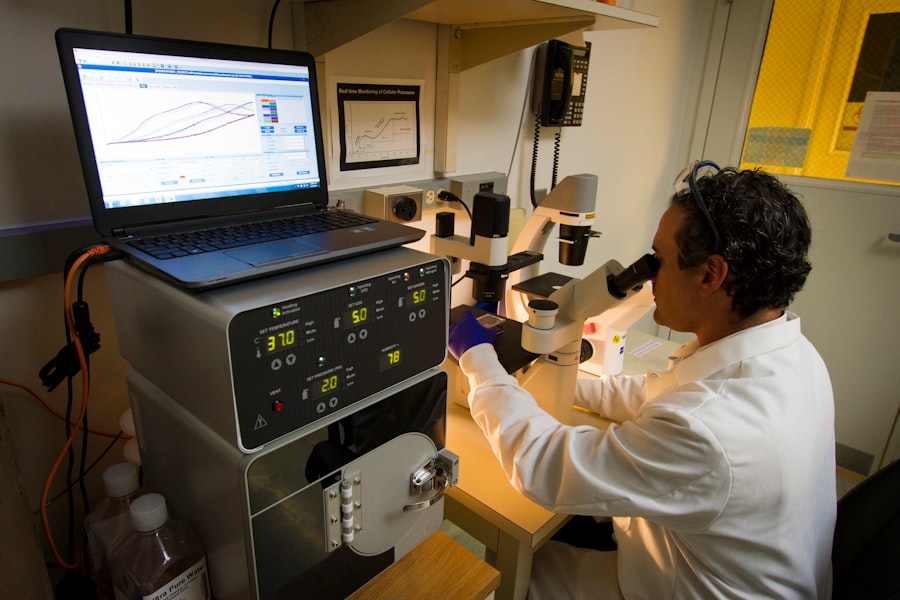
Despite the promising potential of quantum clinical trials, several challenges and ethical considerations must be addressed before widespread implementation can occur. One significant challenge lies in the current limitations of quantum computing technology itself. While advancements are being made rapidly, practical applications remain constrained by issues such as qubit coherence times and error rates.
These technical hurdles must be overcome to ensure that quantum algorithms can be reliably applied in real-world clinical settings. Ethical considerations also play a crucial role in the deployment of quantum clinical trials. The use of advanced technologies raises questions about data privacy and security, particularly when handling sensitive patient information.
Ensuring that robust safeguards are in place to protect patient data is paramount as researchers leverage large datasets for analysis. Additionally, there is a need for transparency in how algorithms are developed and validated to prevent biases that could affect trial outcomes or patient safety. Engaging stakeholders—including patients, ethicists, and regulatory bodies—in discussions about these challenges will be essential for fostering trust and ensuring responsible use of quantum technologies in healthcare.
Future Implications and Potential of Quantum Clinical Trials
The future implications of quantum clinical trials are vast and hold significant promise for advancing healthcare on multiple fronts. As quantum computing technology matures and becomes more accessible, we may witness a shift in how clinical research is conducted across various therapeutic areas. The ability to conduct more efficient trials could lead to an increase in the number of new therapies entering the market, ultimately benefiting patients who are in need of innovative treatments.
Moreover, as personalized medicine continues to gain traction, quantum clinical trials will likely play a pivotal role in tailoring therapies to individual patients based on their unique genetic makeup and health profiles. This could lead to more effective interventions with fewer side effects, as treatments would be designed specifically for those who are most likely to benefit from them. The integration of quantum technologies into healthcare could also facilitate collaborations between academia and industry, fostering an environment where cutting-edge research translates into tangible benefits for patients more rapidly than ever before.
The Promise of Quantum Clinical Trials in Advancing Healthcare
Quantum clinical trials represent a transformative approach to medical research that has the potential to reshape the future of drug development and patient care. By harnessing the power of quantum computing and advanced algorithms, researchers can conduct trials with greater efficiency and precision than ever before. The advantages offered by this innovative methodology—ranging from faster drug discovery timelines to enhanced patient stratification—underscore its promise in addressing some of the most pressing challenges faced by traditional clinical trial models.
As we look ahead, it is clear that the integration of quantum technologies into healthcare will require careful consideration of ethical implications and technical challenges. However, with ongoing advancements in both quantum computing and our understanding of complex biological systems, the potential for quantum clinical trials to revolutionize medical research is immense. By embracing this new frontier, we stand on the cusp of a new era in healthcare that prioritizes innovation and patient-centered approaches, ultimately leading to improved health outcomes for individuals around the world.
